
 Games
Games Game Series
 Guide
Guide
 简体中文
简体中文 हिन्दी
 한국어
한국어 Tiếng Việt
 ไทย
ไทยFollowing the path of its predecessor, SchoolMate 2 arrived in 2010 as a definitive statement from Illusion, proving that the studio was ready to fully commit to the anime aesthetic. While the first game broke ground with the real-time 3D anime shader, the sequel was designed to be a more polished, technically superior experience that leaned into the supernatural mysteries of Japanese school life. It served as a bridge between the experimental “tech demo” phase of the late 2000s and the massive sandbox titles we see today, offering a unique blend of storytelling and deep interaction. For many fans, this title represents the peak of Illusion’s “2010 era,” where the focus was on vibrant colors, expressive characters, and a sense of atmosphere that felt both cozy and haunting.
Before reaching this milestone, the original SchoolMate laid the foundation as one of Illusion’s early experiments with real-time interaction in a school setting, introducing players to a more immersive, character-driven experience. Years later, this concept would be reimagined in a lighter and more playful direction with SchoolMate Sweets, a spin-off that trades the darker undertones for a sweeter, more casual slice-of-life vibe while still preserving the core charm of interactive anime-style relationships.
The game wasn’t just a simple update; it was a total overhaul that utilized the technical advancements seen in Real Girlfriend to deliver smoother animations and more responsive models. By shifting the setting toward the supernatural, Illusion managed to create a narrative hook that justified the intense and often bizarre interactions between the protagonist and the heroines. It was a time when the developer was truly listening to community feedback, implementing features like the highly-requested 3P Mode and a more robust customization system. Whether you are coming to this game for the nostalgia of the early 2010s or looking to see where the roots of modern 3D anime sims began, SchoolMate 2 offers a journey that is as much about the mystery as it is about the romance.
You can buy this game’s CD on Amazon and other online platforms
The Story of SchoolMate 2
The narrative of SchoolMate 2 shifts its focus toward the eerie and the unexplained, placing players in a high school setting that feels like it’s straight out of a classic urban legend. You find yourself involved with the Mystery Seeking Club, a group of students dedicated to investigating the “Seven Mysteries” that haunt the halls of their academy. Unlike the grounded, slice-of-life feel of the first game, the sequel immediately establishes a sense of supernatural dread when the club decides to probe the mystery of the Jizou Sisters. This ancient curse is said to bind those who disturb the sacred shrines of the island, and unfortunately, the protagonist and his classmate, Yukariko, find themselves at the very center of it.

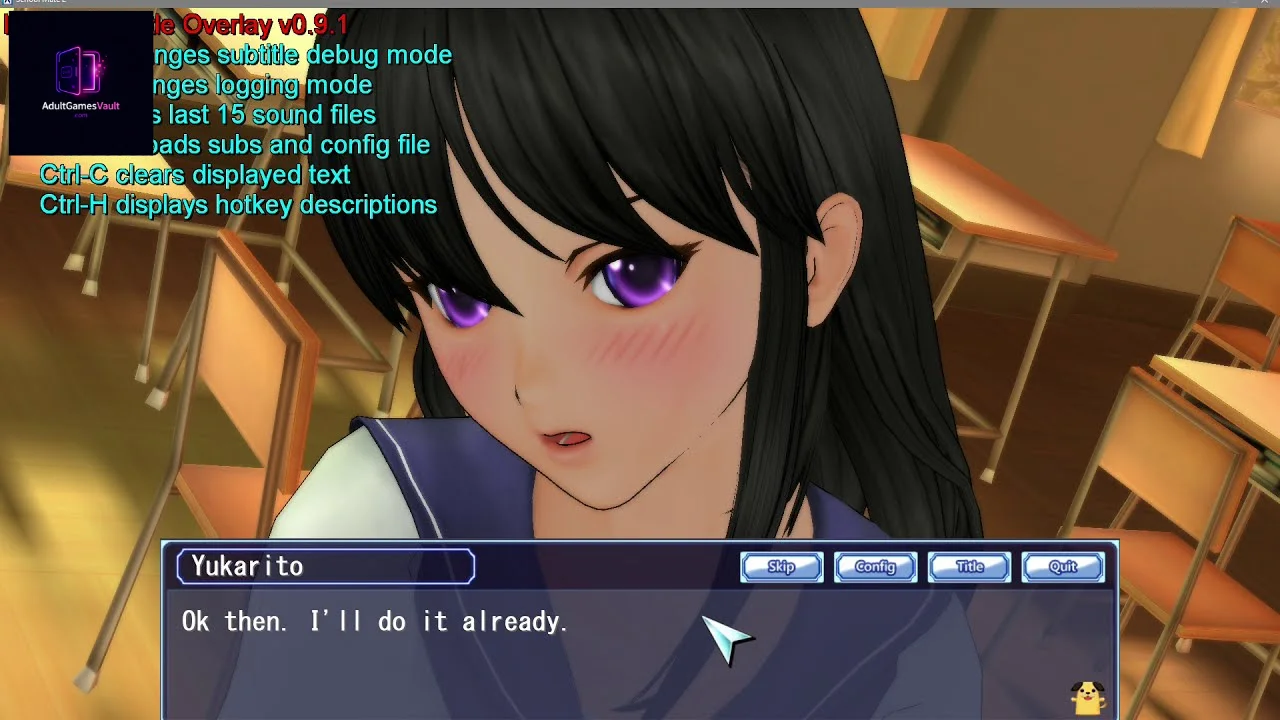
Yukariko is the heart of the story, a friendly and well-liked girl who accidentally triggers the curse while cleaning a neglected shrine. This event doesn’t just invite ghosts into her life; it allows the spirits of the three Jizou sisters—Suho, Asagi, and Kohaku—to manifest and take an obsessive interest in her and the protagonist. These sisters represent different aspects of the curse, each with their own personality and “eye color” cues that hint at their current state of possession. The protagonist is forced to intervene, using his unique connection to the supernatural to appease the sisters’ restless spirits through a series of “rituals” that form the backbone of the game’s interactive scenes.
As the story progresses, the boundary between the physical world and the spirit realm begins to blur. You aren’t just navigating a typical school romance; you are navigating a metaphysical contract where the satisfaction of the sisters is the only way to save Yukariko from being completely consumed by the curse. Each sister brings a different challenge to the narrative, with Suho often being the most aggressive and Asagi being more reserved. Kohaku, the third sister, acts as a balancing force, often guiding the protagonist through the complexities of the rituals. The writing balances the tension of the curse with moments of levity and character growth, making you feel the weight of the responsibility you carry.
The academy itself feels like a different place under the influence of the mystery. The classrooms, the rooftop, and the storage rooms are no longer just settings for school activities; they become stages for the supernatural events to unfold. The “Seven Mysteries” act as a framing device, giving you a reason to explore the darker corners of the school at various times of the day. By the time you reach the final chapters of the story mode, the relationship between the protagonist, Yukariko, and the three sisters has evolved into something complex and inseparable. It is a tale of possession, sacrifice, and the search for a way to break an ancient cycle, ensuring that the narrative remains engaging until the very last ritual is performed.
SchoolMate 2 Gameplay Mechanics
The gameplay of SchoolMate 2 is a significant evolution of the “Story to Free Mode” pipeline that Illusion perfected over the years. You are required to begin your journey in Story Mode, where the game plays out similarly to an interactive fiction title. In this phase, your primary task is to navigate the dialogue and plot points of the Mystery Seeking Club, making key decisions that advance the narrative. Completing these story chapters is essential because they act as the “unlock keys” for the game’s massive Free Mode (or Endless Mode), where the true depth of the 3D simulation is revealed.
One of the most praised mechanical additions is the Mood and Health System, represented by a dynamic color grid. Unlike the static personality traits of the past, the heroines in SchoolMate 2 have shifting emotional states—ranging from Tsun (Defensive) and Dere (Loving) to Lewd (Teasing) and Devoted. Their mood changes based on how you interact with them, the frequency of your encounters, and even the “climax types” you choose. For example, focusing too much on the protagonist’s satisfaction might lead to a girl becoming defensive, while achieving simultaneous climaxes can move her into the “Devoted” zone, unlocking more affectionate dialogue and special poses.
Interaction in the 3D space is handled through a Point System that adds a layer of “shop-style” progression. As you engage in rituals and successfully navigate H-scenes, you earn points that can be spent to purchase a vast array of clothing and accessories. This gives the player a tangible reason to revisit scenes and experiment with different styles. The interaction itself features an Eye-Watching Mechanic, similar to the one found in Artificial Girl 3. To find the “hot spot” or the most effective way to please a character, you must watch their eyes and listen for specific audio cues, making the simulation feel more like a skill-based challenge than a simple sequence of animations.

The standout feature of the sequel is undoubtedly the 3P Mode, which allows the protagonist to interact with two girls simultaneously. This was a technical feat for 2010, requiring the engine to handle multiple 3D models with high-fidelity anime shaders without significant frame drops. The game also includes a Technique and Stamina system for the player, where your performance directly impacts how quickly the girls become aroused and how much “load” you can spend. This blend of management, tactical interaction, and deep customization creates a gameplay loop that is incredibly rewarding for those who enjoy the “sandbox” freedom that Illusion games are known for.
SchoolMate 2 Review and Community Feedback
Upon its release, SchoolMate 2 was hailed by the community as a massive graphical leap over the original. Players were particularly impressed with how the Real-Time Anime Shader had been refined to eliminate the “jittery” lines that sometimes plagued the 2007 version. The inclusion of the 3P mode was a major selling point, with many users on forums like Hongfire and Anime-Sharing sharing screenshots of the complex new positions. The community felt that the game finally delivered on the promise of a “playable anime,” where the character expressions and movements felt fluid and consistent with the 2D art style.

However, the feedback was not universally positive, as some veteran players felt the gameplay depth was still a bit “shallow” compared to the more simulation-heavy Artificial Girl series. While the story was intriguing, the actual “school life” mechanics—like attending classes or managing a schedule—were largely absent, with the game focusing almost entirely on the mystery club and the rituals. Some players also found the Story Mode locks to be a bit tedious, as they wanted to jump straight into the customization without having to read through hours of Japanese text. This led to a vibrant modding community that created “100% Save Files” and translation patches to make the game more accessible to a global audience.
Technically, the game is remembered as a bit of a resource hog for its time. Even though it’s 2D-styled, the real-time lighting and multiple 3D models required a decent GPU to run at a stable 60 FPS. The community often warned about the Japanese Locale requirement, noting that installing the game to a Western Windows directory would frequently cause the launcher to crash. Despite these technical hurdles, the general consensus is that SchoolMate 2 is a classic “must-play” that captures the peak of Illusion’s early-2010s creativity. It remains a beloved title for those who appreciate a dark, supernatural twist on the school simulator genre.
System Requirements for SchoolMate 2
SchoolMate 2 was developed for the Windows XP and Windows 7 era, meaning it is very lightweight for modern PCs but requires specific compatibility settings to run correctly on Windows 10 or 11.
| Component | Minimum Requirements | Recommended Requirements |
| Operating System | Windows XP / Vista / 7 | Windows 7 / 10 / 11 (with Locale Emulator) |
| Processor | Pentium 4 2.4 GHz or equivalent | Intel Core 2 Duo or higher |
| Memory (RAM) | 1 GB RAM | 2 GB RAM or more |
| Graphics | DirectX 9.0c compatible / 256MB VRAM | NVIDIA GeForce 8 series / 512MB VRAM |
| DirectX | Version 9.0c | Version 11 compatible |
| Storage | 3.5 GB available space | 5 GB available space |
Compatibility Note: To avoid the “Black Screen” or “Registry Error” issues common with older Illusion titles, it is highly recommended to install the game in a folder like C:\Illusion\SM2 rather than the default Program Files. You must set your system locale to Japanese or use a tool like AppLocale or Locale Emulator to ensure the text and scripts execute properly.
Conclusion
In the final analysis, SchoolMate 2 stands as a bold and successful evolution of the 3D anime simulator. By weaving together a haunting supernatural mystery with a refined interactive engine, Illusion managed to create an experience that felt both familiar and revolutionary. It moved the franchise away from simple school antics and into the realm of “urban legend” horror-romance, giving players a much stronger reason to invest in the lives and well-being of the characters. The introduction of the mood grid and the 3P mode proved that the developer was committed to pushing the boundaries of what a real-time shader could achieve.
While the game’s focus on rituals over traditional school simulation might not appeal to everyone, its aesthetic charm and technical polish are undeniable. It remains a foundational title that influenced the character creator systems and interaction loops of future hits like Honey Select and Koikatsu. If you are looking for a game that perfectly blends a dark, atmospheric story with some of the best 3D anime visuals of its era, SchoolMate 2 is a journey through the “Seven Mysteries” that you won’t soon forget. It is a vibrant, chaotic, and deeply rewarding chapter in the history of digital romance.
If you’re curious to see how these classic systems evolved into more modern sandbox experiences, Aicomi is a great next step—offering updated visuals, smoother interactions, and a new generation take on anime-style simulation built by former Illusion developers.