
 Games
Games Game Series
 Guide
Guide
 简体中文
简体中文 हिन्दी
 한국어
한국어 Tiếng Việt
 ไทย
ไทยHalf-Demon Shinobi is a roguelite action game published by Mango Party, released on Steam in December 2024. The official Steam page describes it as a game where players guide Manari, an anti-demon ninja, through a dangerous journey while she struggles against both external threats and her own inner demonic side.
What makes the game stand out is its clear roguelite structure. Even in the short public Steam description, the game is framed around repeated runs, survival, and progression, rather than a large open-world adventure or a traditional linear RPG. That gives it a more focused gameplay identity built around challenge, fast advancement, and replayability.
The game also seems to lean heavily into stylized anime presentation. Public community reactions to the promotional PV praise the art style and overall visual appeal, which suggests that presentation is a major part of its identity alongside the action systems.
With its mix of roguelite progression, ninja action, and demon-themed conflict, Half-Demon Shinobi looks like a strong fit for players who enjoy compact action games with a dark fantasy edge and a more run-based structure.
You can buy this game here:
https://store.steampowered.com/app/2460070/HalfDemon_Shinobi/
If you enjoy the fast-paced roguelite structure and dark anime-style action of Half-Demon Shinobi, then DEAD END COLOSSEUM is a great follow-up for players who want another intense survival-focused experience with a harsher, more brutal atmosphere. For something that leans more into dystopian storytelling and urban tension, Dead-End City Blues OD Edition offers a different kind of dark journey with its own gritty identity. And if you want to shift toward a more stylish sci-fi direction while keeping the action-heavy appeal, X-Angels is another interesting title to explore.
The Story of Half-Demon Shinobi
The story of Half-Demon Shinobi centers on Manari, an anti-demon ninja whose mission is to eliminate a growing demonic threat. What makes the setup more interesting than a simple monster-hunting story is that Manari is not only fighting demons outside herself, but also struggling against her own inner demonic side, which gives the game a stronger internal conflict from the start.
That premise gives the narrative a darker tone than a typical ninja adventure. Instead of a clean hero-versus-evil structure, the story is shaped by the tension between duty and corruption, with Manari’s journey defined by both survival and self-control. Public descriptions consistently frame her as a heroine trying to stop demon terror while resisting what is happening inside her, which suggests that the emotional conflict is meant to be just as important as the external one.
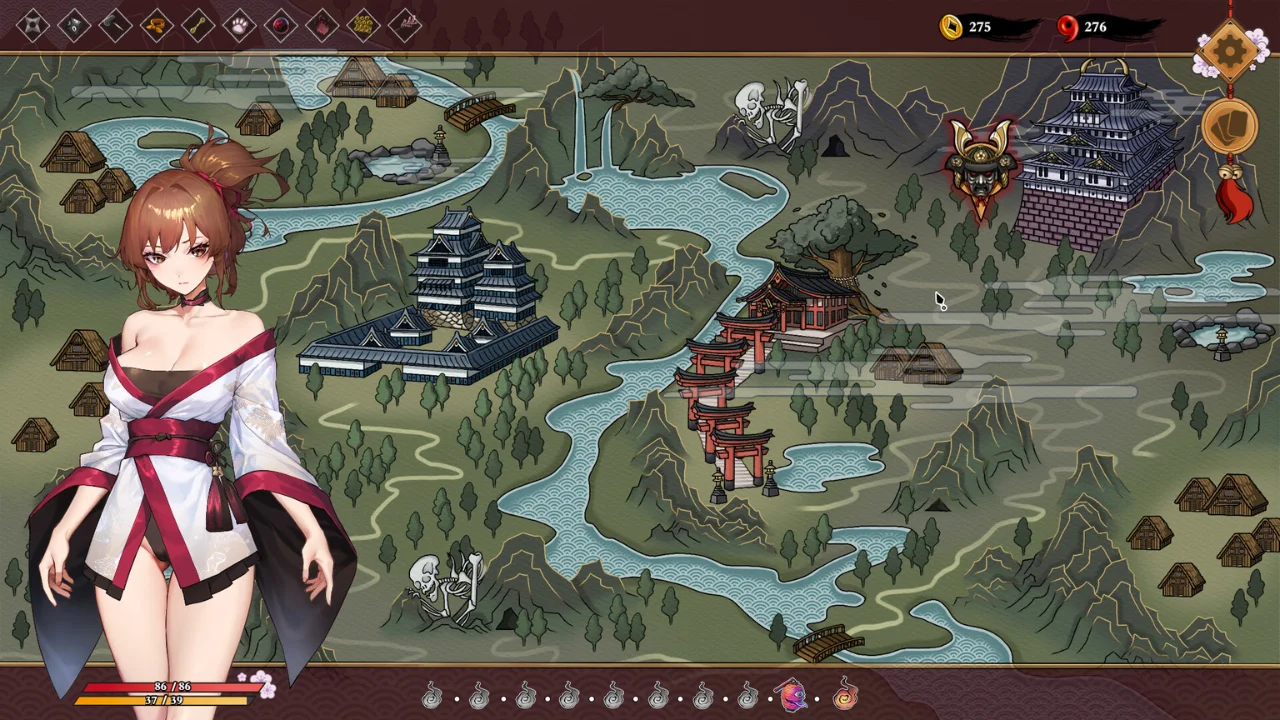
Because the game is presented as a rogue-lite deck-building adventure, the story likely unfolds through repeated runs and gradual progression rather than through one long continuous campaign. That structure fits the premise well, since each attempt can feel like another stage in Manari’s struggle to push deeper into danger while keeping herself from losing control. This is also consistent with player discussion that focuses on builds, replay structure, and route progression rather than on a purely linear story.
Overall, Half-Demon Shinobi tells a dark ninja fantasy story about a demon hunter forced to confront both an external evil and her own inner darkness, giving the game a more personal and conflict-driven hook than a standard action roguelite.
Half-Demon Shinobi Gameplay
The gameplay of Half-Demon Shinobi is built around a roguelite structure with deck-building elements, giving it a different rhythm from a standard action RPG or linear ninja adventure. Instead of progressing through one fixed campaign in a straight line, players go through repeated runs, build their setup over time, and adapt their strategy based on what each attempt gives them.
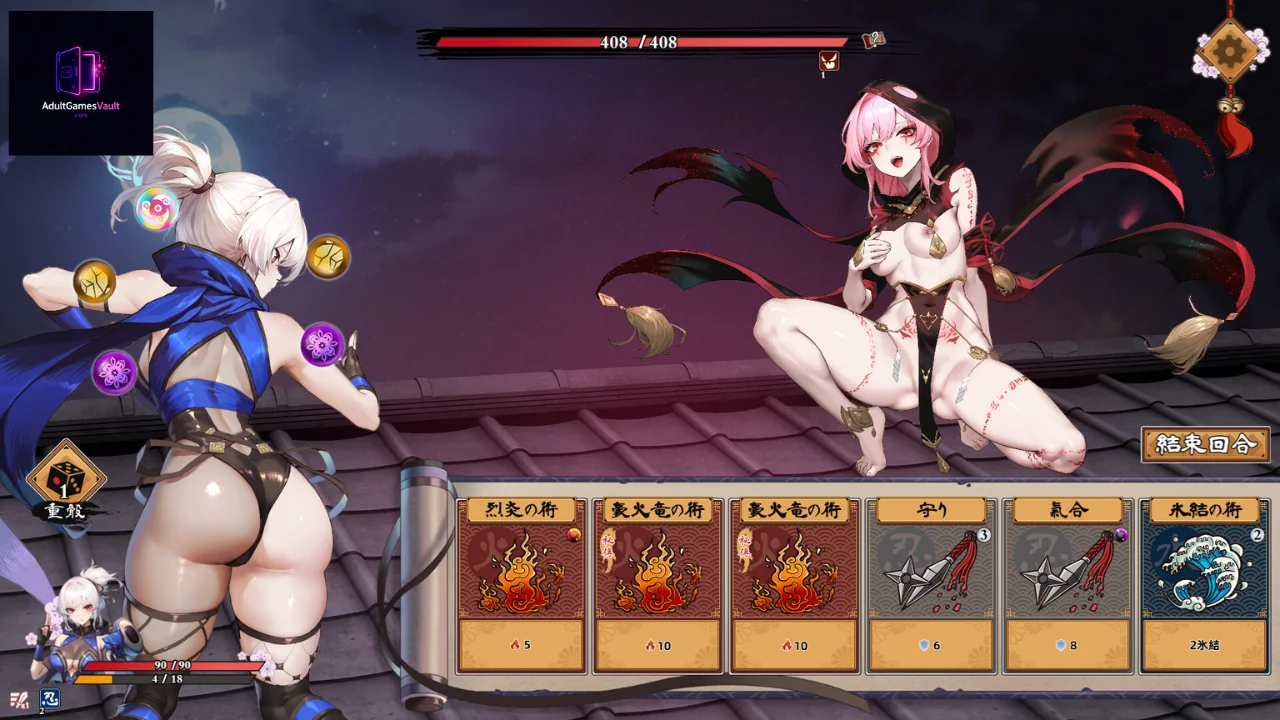
One of the game’s core features is its deck-building system. Rather than relying only on reflex-based combat, players shape each run through card choices, build combinations, and progression decisions. That gives the game a more strategic identity, since success depends not just on surviving encounters, but also on how well you assemble and optimize your build.
The game also appears to center strongly on run-based progression. Each attempt functions as another chance to push forward, improve your strategy, and get closer to mastering the system. That structure naturally supports replayability, which is one of the biggest appeals of roguelites in general.
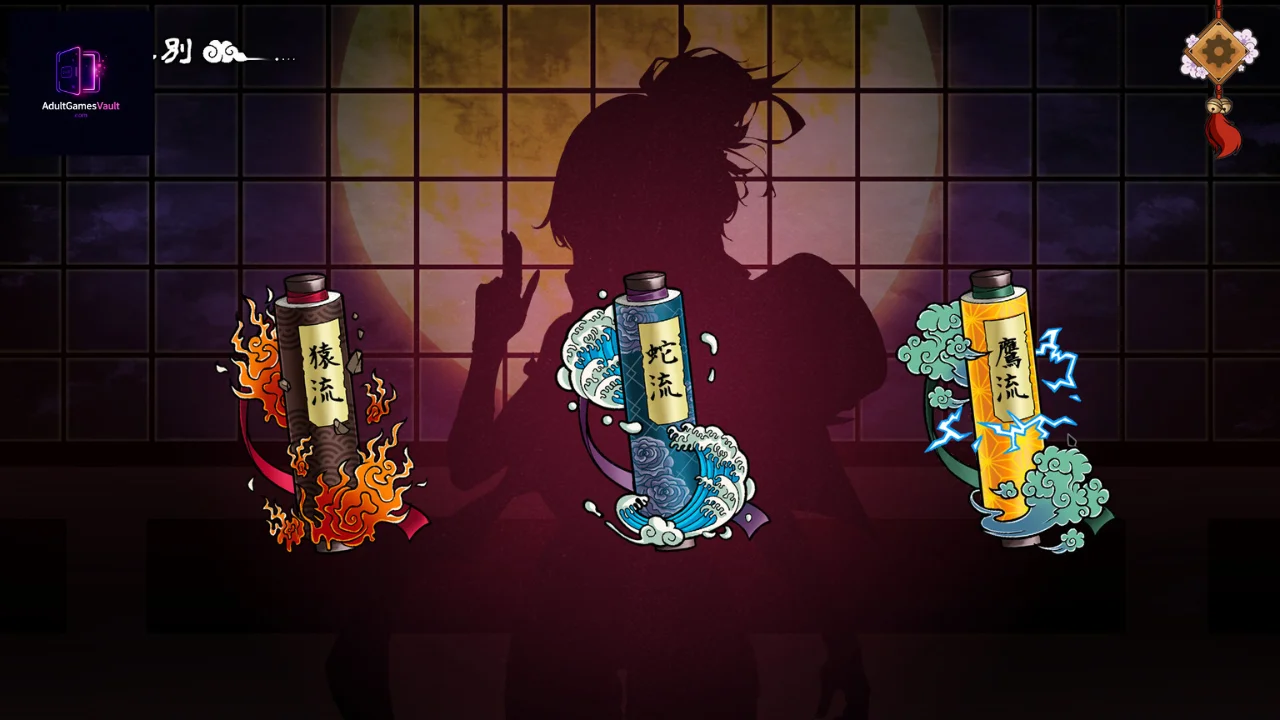
Another important part of the experience is Manari’s identity as a ninja heroine fighting demons. That theme gives the gameplay a darker fantasy edge, while also making the progression feel more personal. Since the story revolves around both demon hunting and resisting her inner darkness, the gameplay likely reinforces that tension through the kinds of encounters, upgrades, and route decisions players face during each run.
Overall, Half-Demon Shinobi looks like a game centered on deck-building strategy, repeated runs, and dark fantasy progression, making it a strong fit for players who enjoy roguelites that reward experimentation, adaptation, and steady mastery over time.
Half-Demon Shinobi Review and Community Feedback
Half-Demon Shinobi has been received very well by its target audience. Steam-facing sources currently place it in the Very Positive range, with third-party trackers showing roughly 89–90% positive user reviews after release, which is a strong result for a niche roguelite deckbuilder.
One of the game’s biggest strengths seems to be its deck-building structure and build variety. The Steam store snippet specifically highlights that “builds are easily recognizable” and that the game includes mechanics that help players complete different builds more smoothly, which suggests the progression system feels readable and rewarding rather than overly random.
Public user reviews also point to the game’s strategic depth as a major positive. One highly rated Steam recommendation describes it as a strong pick for fans of roguelite deck-building games, praising its custom ninja builds, strategic combat, and replay-friendly structure.

At the same time, not every reaction is fully glowing. Public negative review snippets show that some players see the combat as shallower than they hoped, criticizing the characters as generic and the overall battle system as less deep than top-tier deckbuilders. Broader community discussion on Reddit also suggests that while the game is “very solid overall,” some flaws become harder to ignore after longer playtime.
Overall, Half-Demon Shinobi comes across as a well-liked niche roguelite deckbuilder whose biggest selling points are its strong build identity, anime presentation, and replayable run-based progression, even if some players feel it does not fully reach the depth of the genre’s best-known heavyweights.
System Requirements for Half-Demon Shinobi
Before installing Half-Demon Shinobi, it’s worth checking the official PC requirements. Steam’s public snippet lists the game as needing Windows 7 / 8 / 10, an Intel Core i3, 4 GB RAM, an NVIDIA GeForce GTX 560 / AMD Radeon HD 6870, DirectX 11, and 2 GB of storage at minimum. Third-party Steam trackers also show a recommended target of 8 GB RAM, GTX 760-class graphics, and 4 GB of storage, which gives a clearer picture of what a smoother setup looks like.
| Component | Minimum Requirements | Recommended Requirements |
| Operating System | Windows 7 / 8 / 10 | Windows 7 / 8 / 10 |
| Processor | Intel Core i3 | Intel Core i3 |
| Memory (RAM) | 4 GB RAM | 8 GB RAM |
| Graphics | NVIDIA GeForce GTX 560 / AMD Radeon HD 6870 | NVIDIA GeForce GTX 760 / AMD Radeon HD 6870 |
| DirectX | Version 11 | Version 11 |
| Storage | 2 GB available space | 4 GB available space |
| Sound Card | DirectSound | DirectSound |
Overall, Half-Demon Shinobi falls into the low-to-moderate requirement range. It is much easier to run than a large 3D action game, but it still benefits from having a dedicated GPU and a bit more RAM if you want a more stable experience during longer runs.
Conclusion
Overall, Half-Demon Shinobi looks like a focused roguelite action game built around run-based progression, ninja combat, and Manari’s internal struggle against her demonic side. Its strongest identity comes from the way it combines a dark fantasy premise with a structure that seems designed for repeated attempts, fast recovery, and gradual mastery rather than one long linear adventure.
One of the game’s biggest strengths is its clear gameplay hook. The combination of an anti-demon ninja heroine, roguelite progression, and a strong anime presentation gives it a distinctive niche right away. Public community reactions to the promotional material also suggest that the visual style is a major part of the appeal, helping the game stand out from more generic action releases.
At the same time, the game seems best suited to players who already enjoy compact action games with replayable structure. Since the public-facing identity of the game leans heavily into roguelite runs and direct combat rather than broad exploration or deep simulation systems, it will likely land best with players who want a more concentrated challenge-driven experience.
For players looking for a stylized ninja roguelite with dark fantasy themes, repeat-run progression, and a strong heroine-led premise, Half-Demon Shinobi comes across as a promising and visually distinctive title.