
 Games
Games Game Series
 Guide
Guide
 简体中文
简体中文 हिन्दी
 한국어
한국어 Tiếng Việt
 ไทย
ไทยWhen exploring the vast history of 18+ adult gaming, few developers hold as much prestige and absolute industry respect as AliceSoft. While they are most globally recognized for the legendary, multi-decade-spanning Rance franchise, the studio has consistently experimented with blending deep, hardcore gameplay mechanics with high-quality visual novel storytelling. Released in 2003, Daibanchou -Big Bang Age- stands as one of their crowning achievements in the grand strategy and territory conquest genre.
Serving as the direct mechanical predecessor to the wildly acclaimed Sengoku Rance, this title completely eschews the traditional, passive reading experience of standard visual novels. Instead, it thrusts the player into a highly addictive, incredibly challenging loop of resource management, tactical grid-based combat, and nation-conquering strategy. It takes the classic Japanese “Banchou” (delinquent student gang leader) anime tropes and violently collides them with a post-apocalyptic, sci-fi setting.
Because of its massive, sprawling narrative and complex mechanics, the game cultivated a fierce cult following. While it was never officially localized for Western digital storefronts, a monumental, years-long effort by the fan translation community eventually brought this masterpiece to English-speaking audiences, solidifying its status as an absolute must-play for fans of strategy RPGs.
The Story of Daibanchou -Big Bang Age-
The narrative setup of Daibanchou -Big Bang Age- is an absolutely brilliant, high-octane parody of classic Shounen manga and delinquent culture, mixed with serious geopolitical stakes.
The story takes place in a fictionalized, slightly futuristic version of Japan. The country has been completely devastated by a catastrophic, supernatural event known simply as the “Hole.” This massive, swirling vortex opened up in the center of the nation, plunging the world into chaos and unleashing a mysterious dark energy known as “B-Plasm.” This energy had a bizarre effect on the population: it granted teenagers and young adults incredible, supernatural powers, while simultaneously causing the older, adult population to lose their minds or succumb to demonic possession.
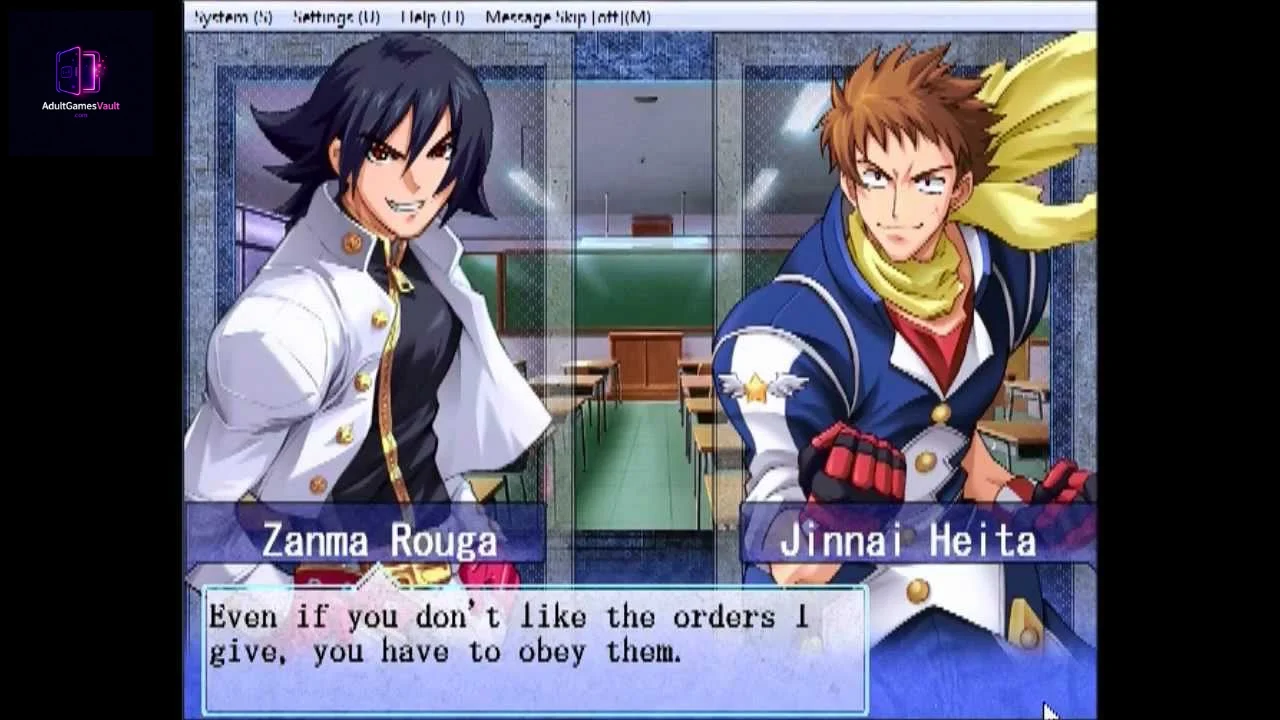
With the traditional government completely collapsed and the military rendered useless, Japan quickly fractures into a warring states period. The country is carved up and ruled by massive, super-powered high school gangs led by formidable Banchou.
You take on the role of Rouga Zanma, a notoriously powerful, fiercely independent, and incredibly stoic Banchou known as the “Wolf.” Operating out of his home territory, Rouga realizes that the only way to restore order to a fractured Japan, stop the demonic entities pouring out of the Hole, and protect the people he cares about is to achieve absolute, total unification. He sets out on a massive military campaign to systematically conquer every single prefecture in Japan.
Unlike many blank-slate protagonists, Rouga is a fantastic, highly defined lead character. He is tough, uncompromising, and highly strategic, but he also possesses a strong moral compass that earns him the fierce loyalty of his subordinates. As you march across Japan, you will encounter dozens of rival gangs, ranging from hilarious, incompetent delinquents to terrifying, heavily militarized student councils. The story perfectly balances over-the-top, hot-blooded anime action with genuinely emotional character arcs and deep world-building.
Gameplay and Strategic Mechanics
If you approach Daibanchou -Big Bang Age- expecting a simple dating simulator, you will be met with an immediate and brutal “Game Over” screen. This is a hardcore grand strategy game that requires careful planning, resource management, and tactical foresight.
Territory Management and the Phase System
The core gameplay loop revolves around a map of Japan divided into numerous distinct territories. The game operates on a strict turn-based system, divided into the Event Phase and the Action/Battle Phase.
During the Event Phase, you manage your empire. You must allocate your hard-earned funds to heal wounded officers, trigger specific narrative events to recruit new characters, or spend time with your female officers to build their affection (which directly translates to stat boosts). Money is incredibly tight in the early game, forcing you to constantly make agonizing decisions between healing your front-line fighters or saving up to recruit a powerful captured enemy.
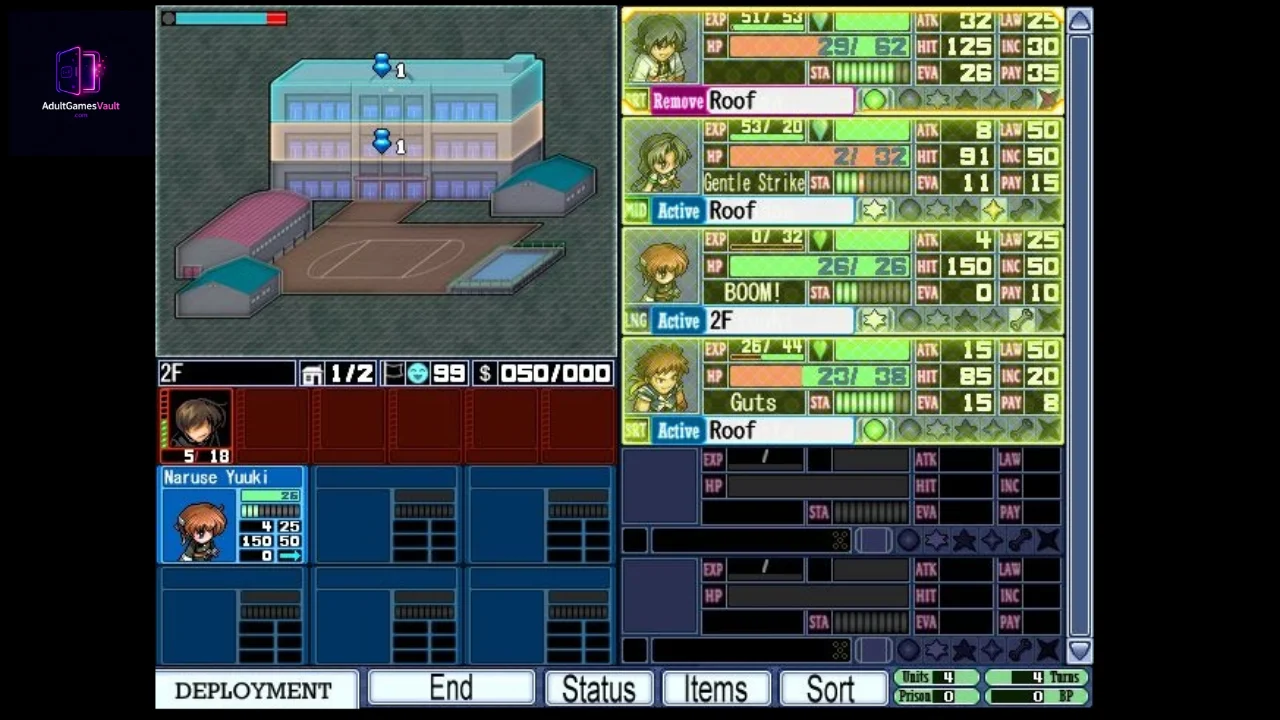
During the Action Phase, you command your armies. You must strategically assign your recruited officers to defend your borders against counter-attacking rival gangs while simultaneously pushing forward to conquer new regions. Leaving a border completely undefended will result in an immediate loss of territory, meaning you can never simply rush blindly toward the enemy capital.
Grid-Based Tactical Combat
When two armies clash, the game transitions into a highly engaging, lane-based tactical battle screen. You can deploy a limited number of officers into the front and back rows. Positioning is absolutely critical to your success.
Melee fighters like Rouga must be placed in the front row to deal massive damage and absorb enemy strikes, while frail snipers, magical healers, and support units must be protected in the back row. Every character possesses specific stats (HP, Attack, Accuracy, Evade) and unique, game-changing skills. Some characters can counter-attack, some can strike multiple lanes simultaneously, and others can completely nullify enemy magic. Learning the synergies between your dozens of recruited officers and building the perfect strike team to counter specific enemy bosses is incredibly satisfying.

Recruitment and 18+ Character Progression
As you conquer territories and defeat rival gangs, you will frequently capture enemy officers. In a brilliant mechanical twist, you can use your financial resources to persuade these prisoners to join your army. Daibanchou features a massive roster of over 60 recruitable characters, each with their own unique artwork, voice acting, and combat abilities.
Building a massive, diverse army is the key to survival. For the female officers you recruit, the game seamlessly integrates its 18+ visual novel elements into the progression system. By spending time with them during the Event Phase and completing their specific character quests, you unlock highly detailed, romantic adult sequences. These scenes are not just for show; maximizing a heroine’s affection through these events often unlocks their ultimate combat abilities or permanently increases their stats, perfectly blending the narrative romance with the hardcore strategy mechanics.
Community Feedback for Daibanchou
Within the English-speaking visual novel and retro gaming communities, Daibanchou -Big Bang Age- is widely considered a masterpiece, frequently mentioned in the same breath as AliceSoft’s greatest hits.
What Players Love
The most universal praise directed at the game is its phenomenal, highly addictive “one more turn” gameplay loop. The grand strategy mechanics are deep, rewarding, and incredibly well-paced. The thrill of slowly painting the map of Japan with your faction’s colors, capturing a boss who gave you trouble hours earlier, and turning them into your most powerful ally is a feeling that very few games can replicate.
The community also holds the game’s massive ensemble cast in incredibly high regard. Characters like the fan-favorite ninja Senna, the brilliant tactician Sanada, and the fiery rival Kyouko are iconic. The sheer volume of content, secret recruitable characters, and hidden story routes provides massive replayability.

Constructive Criticism
On the critical side, the game is absolutely infamous for its brutal difficulty spikes. Daibanchou does not hold the player’s hand. If you expand your territory too quickly without properly defending your borders, or if you waste your money on useless recruits in the early game, you can easily find yourself completely soft-locked ten hours into a campaign, completely overwhelmed by multiple rival factions attacking you simultaneously. The learning curve is incredibly steep, and saving your game in multiple different slots is absolutely mandatory.
Additionally, because the game was released in 2003, the user interface shows its age. Managing a massive army of 50+ officers through clunky, early-2000s drop-down menus can eventually become a bit of a logistical chore in the late game.
The Monumental Fan Translation
It is impossible to discuss the legacy of this game in the West without highlighting the heroic efforts of the fan translation community. Daibanchou contains an absolutely staggering amount of text—thousands of pages of dialogue, item descriptions, and combat logs. The fact that a dedicated team of fans managed to translate the entire game into high-quality English, hacking the original 2003 engine to display Western text properly, is one of the greatest achievements in the history of visual novel preservation.
System Requirements
Because it is a 2D sprite-based grand strategy game from 2003, Daibanchou -Big Bang Age- requires absolutely no dedicated modern gaming hardware. The only real hurdle is software compatibility, which the modern fan-translation patches largely fix automatically.
| COMPONENT | MINIMUM REQUIREMENTS | RECOMMENDED REQUIREMENTS |
| Operating System | Windows 98 / 2000 / XP | Windows 10 / 11 (Requires Fan Translation Patch) |
| Processor | Intel Pentium III 800 MHz | Intel Core2 Duo or any modern CPU |
| Memory (RAM) | 256 MB RAM | 1 GB RAM |
| Graphics | DirectDraw Compatible GPU (32 MB) | Any modern integrated or dedicated GPU |
| DirectX | Version 8.1 | Version 9.0c |
| Storage | 2 GB available space | 3 GB available space |
Optimization Note: If you are attempting to play the original, unpatched Japanese release on Windows 10 or 11, the game will suffer from severe registry errors and unreadable text. You must apply the full English Fan Translation patch, which not only translates the game but also updates the executable to run smoothly and natively on modern 64-bit operating systems without the need for a Japanese Locale Emulator.
Conclusion
Daibanchou -Big Bang Age- is an absolute titan of the 18+ strategic gaming genre. By perfectly blending the hardcore, map-painting grand strategy of a classic Koei game with the colorful, hot-blooded aesthetic of a delinquent anime, AliceSoft created an experience that has truly stood the test of time.
While its steep learning curve and punishing difficulty spikes may intimidate players looking for a casual visual novel experience, those who are willing to master its deep resource management and tactical grid combat will find one of the most rewarding games in the studio’s history. With an unforgettable cast of characters, a brilliant territory conquest system, and a perfectly integrated progression loop, Daibanchou remains a legendary cult classic that paved the way for the modern golden age of adult SRPGs.